
Inside Putnam Property Tax Records
Three offices split Putnam County property tax records: the Assessor, the Auditor, and the Treasurer. Copy every figure with its label and year. Gross assessed value, net assessed value, and a bill total answer three different questions. The Putnam County Assessor publishes the official Think GIS route. The Treasurer provides tax-list and payment access.
| Field | What It Shows | Where |
|---|---|---|
| Land, improvement, total value | Components of the parcel's gross assessment | Assessor or parcel card |
| Deductions and exemptions | Adjustments used to reach net assessed value | Auditor and assessment records |
| Tax district | The district tied to the parcel's tax administration | Tax list and parcel record |
| Bill and payment status | Charges, payment, or delinquency for the bill year | Treasurer |
| Form 11 and appeal | Assessment notice and contest process | Assessor and PTABOA |
Indiana assesses property at a 100 percent ratio under a market-value-in-use standard. That does not equal an asking price. Nor does it equal a private appraisal or one sale figure. Annual trending, mass appraisal, parcel characteristics, deductions, and the tax levy all shape the numbers. Putnam County property tax records show those combined effects.
Three Putnam Tax Office Roles
The Assessor sets the value. Appeals begin there, too. The Auditor handles deductions, exemptions, and deed-related charges. The Treasurer bills, collects, and posts tax-sale information. A single parcel can cross Recorder, Plat Office, Assessor, and Auditor before final recording, so the same land may sit at different stages in different systems. That split matters most after a new deed. Keep the newest instrument date, parcel-card year, and tax-list update marker together, and when records disagree, ask which review is still pending before assuming one screen is wrong.
Search Putnam County Tax Fields
The Putnam County tax list takes three documented keys. A last name works best. The instructions also want the city included with any property address, since too much text can narrow away a match.
| Search key | How to enter it | What to preserve |
|---|---|---|
| Parcel Number | Use the complete number from an official result. | District, parcel, legal or other ID |
| Name | Begin with the last name, then test exact variants. | Name as displayed and update marker |
| Property Address | Include the city, but trim excess text after no match. | Displayed address and parcel link |
Results show District, Parcel Number, a legal or other identifier, Name, and Property Address. The list carries a “Not for Official Use” label. Parcels recently split or combined may be easier to find by last name.
Retrieve a Putnam County Tax Bill
Keep the assessment record and the Treasurer record side by side when you pull a bill. Start with an address. Grab the full parcel number next. Once a result supplies it, the parcel key is safer when a rural address changes or several records share a surname.
- Search by property address, name, or complete parcel number. Save the district and displayed identifier.
- Open the Treasurer payment route and choose the correct bill year. Read the amount and status in that year's context.
- Compare land, improvement, gross, deduction, and net values against the assessment record when shown.
- Check official tax-sale sources if delinquency appears. A sale certificate is not a tax deed.
- Assessed value
- The value assigned for property-tax administration under Indiana rules.
- Levy
- The amount a taxing unit raises through property tax.
- Homestead deduction
- A qualifying reduction reflected in tax administration, not title.
- Tax lien
- A legal claim tied to unpaid property tax.
Putnam Assessments Versus Sale Price
The Indiana DLGF assessment overview explains the ratio and trending. Market value-in-use looks at current use. Mass appraisal never copies a parcel-specific private appraisal. One transfer is not the whole market. Putnam guidance also separates money transfers from no-consideration events. Gifts, family transfers, trust transfers, and certain name changes can show little or no price, which is why such figures may not be ordinary comparable sales. Review Putnam County's Sales Disclosures and Deeds guidance.
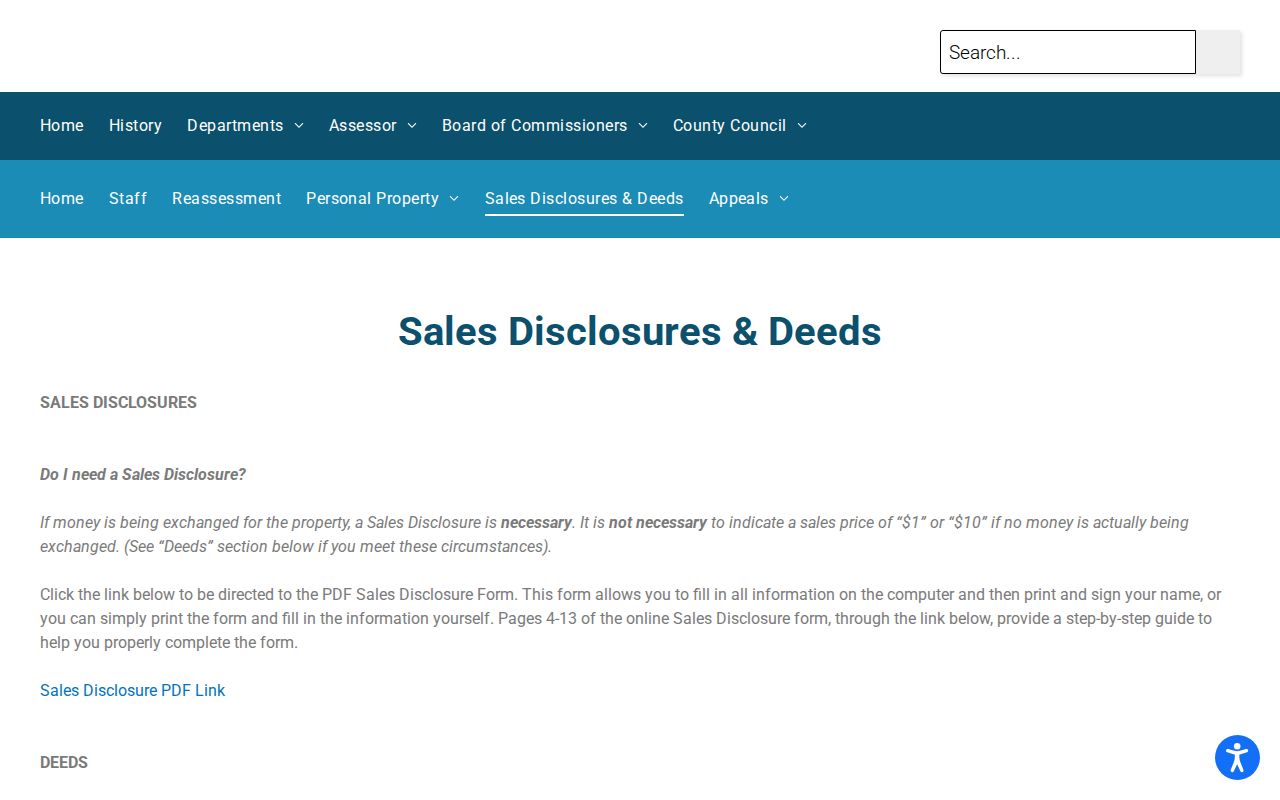
That guidance maps a transfer's path office by office.
Putnam Values in the New Cycle
Indiana's statewide cyclical reassessment begins July 1, 2026, for 2026 Pay 2027. It continues for four more years. DLGF physically reviews about a quarter of parcels yearly. Values can move without a deed. Putnam County property tax records may shift because of physical review, annual trending, corrected characteristics, or an appeal. Check the assessment year before comparing figures. A later value proves no sale by itself. Pair any shift with parcel characteristics, deed history, permits when relevant, and the official notice to see what really changed.
Note: The statewide cycle does not mean every Putnam parcel changes value in the same year.
Putnam Tax Sale Status
The Treasurer's tax-sale information separates delinquency, sale, certificate, redemption, and deed. A certificate is not ownership. Title needs a later recorded deed. Build a date ladder. Cover delinquency, certification, notice, sale, certificate, redemption deadline, tax deed if issued, and later conveyance. Check court records when litigation touches the parcel, since each stage carries its own legal effect.
Putnam Deductions Change Net Value
Deductions can make net assessed value differ from gross assessed value. The parcel's underlying assessment stays the same. Putnam County materials point to homestead, senior, blind or disabled, and veteran relief as records to check. Eligibility rules shift. Amounts, filing dates, and phase-ins change too, so rely on the current Auditor or county form rather than an old summary. Match the deduction to the right parcel and year. If expected relief is absent, ask the Auditor which application, proof, and deadline apply. A deduction entry is a tax-administration fact. It proves no occupancy and no deed interest.
Contest a Putnam County Assessment
Putnam County gives taxpayers distinct forms for distinct problems. The Putnam County appeal pages lay out the difference. Form 11 is simply the assessment notice. A subjective dispute over valuation goes on Form 130. Objective errors, by contrast, go on Form 133. Each parcel needs its own filing, and the matter moves through the Assessor and the Property Tax Assessment Board of Appeals, known as PTABOA. The clock matters with Form 130. Putnam County requires that appeal within 45 days of the Form 11 notice date. Strong evidence might include sales, comparable parcels, photographs, condition facts, and property records that speak directly to the disputed assessment. After the local hearing, follow the county's continuance, withdrawal, and Indiana Board of Tax Review procedures whenever they apply.
Appeal window. A Putnam County Form 130 appeal must be filed within 45 days of the Form 11 notice date, separately for each parcel.
Build Putnam Appeal Evidence
Good appeal evidence is targeted. Build the file around the parcel and the assessment date at issue. Keep the Form 11, the property record card, photographs, dated condition facts, relevant sales, and comparable parcel records handy. A raw list of addresses persuades no one. Explain your adjustments instead. If the dispute moves past local review, the Indiana Board of Tax Review's evidence guidance helps frame market-value-in-use proof. Match the appeal to the problem. Objective errors follow the correction route. A judgment about value takes the subjective route with the proper appeal form. Never mix a tax-payment dispute into a value dispute. When a bill is wrong because a deduction never posted, start with the Auditor. When the land or improvement value itself is contested, start with the Assessor. Along the way, preserve proof of filing and every hearing notice Putnam County sends.
Request Putnam Tax Records Offline
Online access is only one channel. Putnam County keeps its offices open by phone, counter, email, and mail. The Assessor, at (765) 653-4312 or assessor@co.putnam.in.us, handles assessment records and field questions. Direct bill, payment, and sale status questions to the Treasurer. Deduction and exemption administration sits with the Auditor. Whatever the channel, include the parcel number. Also give the property address, record type, and tax or assessment year. The Indiana Access to Public Records Act, IC 5-14-3, governs these requests. Ask for an existing record with reasonable particularity. The agency need not answer a broad question or build a custom report. An oral, in-person, or phone request carries a 24-hour acknowledgment rule. A mail, fax, or email request carries a seven-calendar-day rule. Those deadlines govern acknowledgment only, not production. Also ask about the available format. Ask about the current copy charge and any redactions. Request a written description of anything withheld. A complete request can cover a lot of ground. It might seek the parcel record card. It might name a specific assessment year. It might also request the Form 11 notice, deduction or exemption records, bill and payment history, delinquency notices, and any tax-sale entry. Send each part to the office that keeps it. State whether you want inspection, an electronic copy, or a certified paper copy. If an office redirects the request, save that response. Update the custodian in your search log. Portals sometimes come up empty. That is not the end. Report the exact address, parcel number, name form, year, and search date. Then retry with less address text, a surname, or a prior parcel number. Remember that "no web result" is not an office statement. It does not mean no responsive property tax record exists. That distinction matters most for recent splits and combinations. It also matters for a deed still moving through county review.