
Start a Putnam County Property Search
Anchor the search first. Run the street address through Putnam County Think GIS, open the parcel, and save the parcel number along with any legal-description clues. Those keys outperform a name. They match the same tract in the Treasurer's tax list, the Recorder's document index, and the Plat Office books. Log each source and when you pulled it. Parcels get split or combined, and an older deed may still carry an earlier number.
Give each result its own job. Assessment and tax systems track a parcel's current administrative record. The newest recorded instrument governs a transfer. A plat or survey answers boundary questions a GIS line cannot. No single search proves clear title.
- Normalize the address, then locate it in Putnam County Think GIS.
- Save the parcel number, map location, legal description, and exact name label shown.
- Search that name and legal-description clues in the Recorder's Doxpop index.
- Cross-check the parcel in the Treasurer tax list and note its update date.
- Ask the Recorder, Plat Office, or Clerk for the official copy when the web record is not enough.
Putnam County Records Custodians
Putnam County property records pass through several courthouse offices. The Recorder preserves deeds, mortgages, releases, liens, easements, and plats. The Assessor maintains assessment information and links the data to Think GIS. The Plat Office checks legal descriptions, keeps plat books and aerials, and handles parcel splits. The Auditor processes transfers and deductions. The Treasurer handles bills, payments, and tax-sale information. A recent transfer may reach the deed index first. Not every tax or map record catches up right away.
Putnam County Document Search
Deeds reach the public through the Doxpop recorded-document portal. So do most other recorded instruments for Putnam County. Start with party names. Run the grantor and grantee roles for the same people. Subscription access adds legal-description and document-information searching. The index reaches back to January 1992, with images from January 1993. Older stretches of a chain still live in deed books. Check the Recorder, the Plat Office, or the archives.
A result usually lists the parties, document type, recording date, instrument or book-and-page reference, and a legal-description clue. Image availability shows there as well. Document-type options vary, so confirm them in the live portal. For a consequential transfer, pull the image or order a certified copy from the Recorder.
The Putnam recorded-document result interface shows the fields behind each hit. Treat the index as a finding aid.
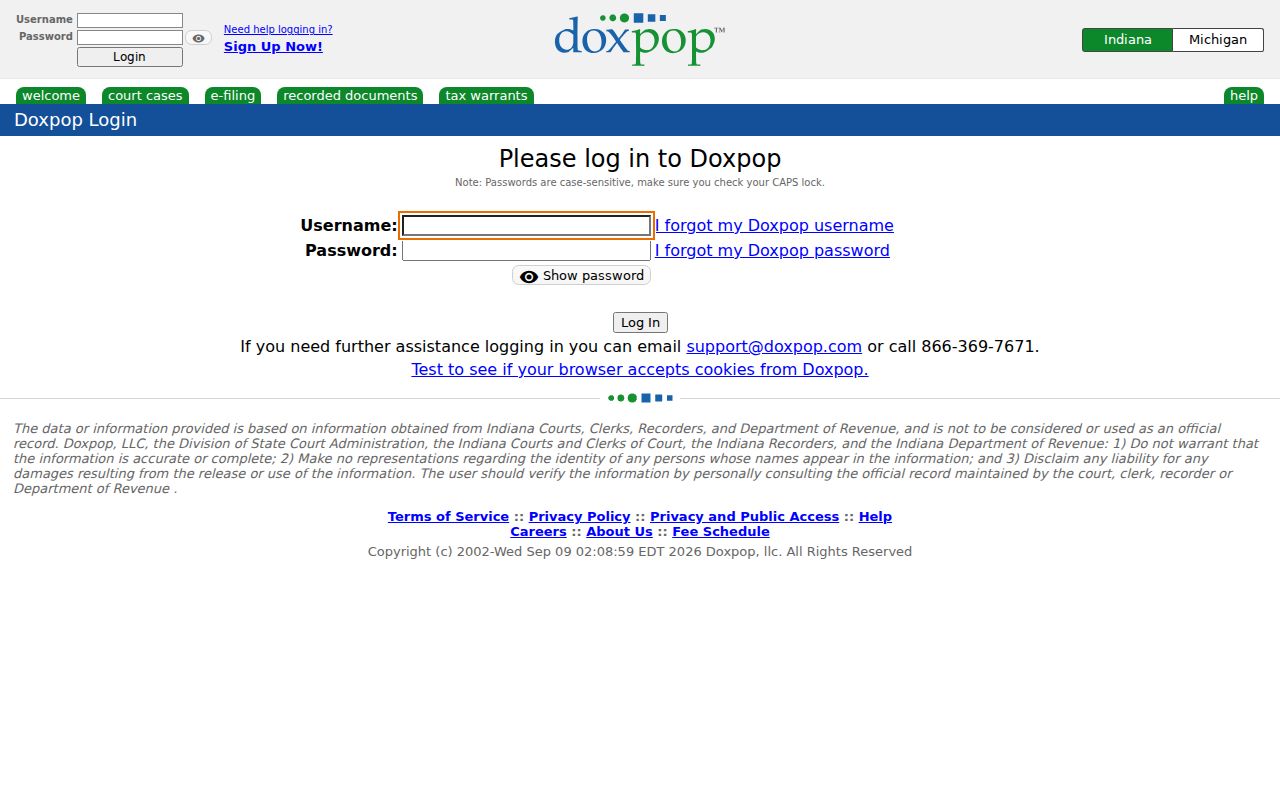
Preserve the result details. Then tie every line back to the official instrument before relying on it.
Putnam County Parcel Values
Indiana assesses real property at 100 percent of market value-in-use. That is a tax standard, not a forecast of sale price. A Putnam County assessment record splits land, improvement, and total amounts by assessment year. Trending moves the figure annually. A physical review or corrected characteristic shifts it too. A deduction change can shift it as well, and no sale is needed. The statewide cyclical reassessment starting July 1, 2026 spans four years. Roughly a quarter of parcels are physically reviewed each year.
Note the assessment year behind any figure. A Sales Disclosure often explains a transfer. Family, gift, trust, and corrective deeds carry no market signal as comparable sales, though. The Putnam County Assessor and Indiana DLGF definitions anchor the vocabulary.
The assessor's page connects local records to the state assessment framework. Use that lens first.
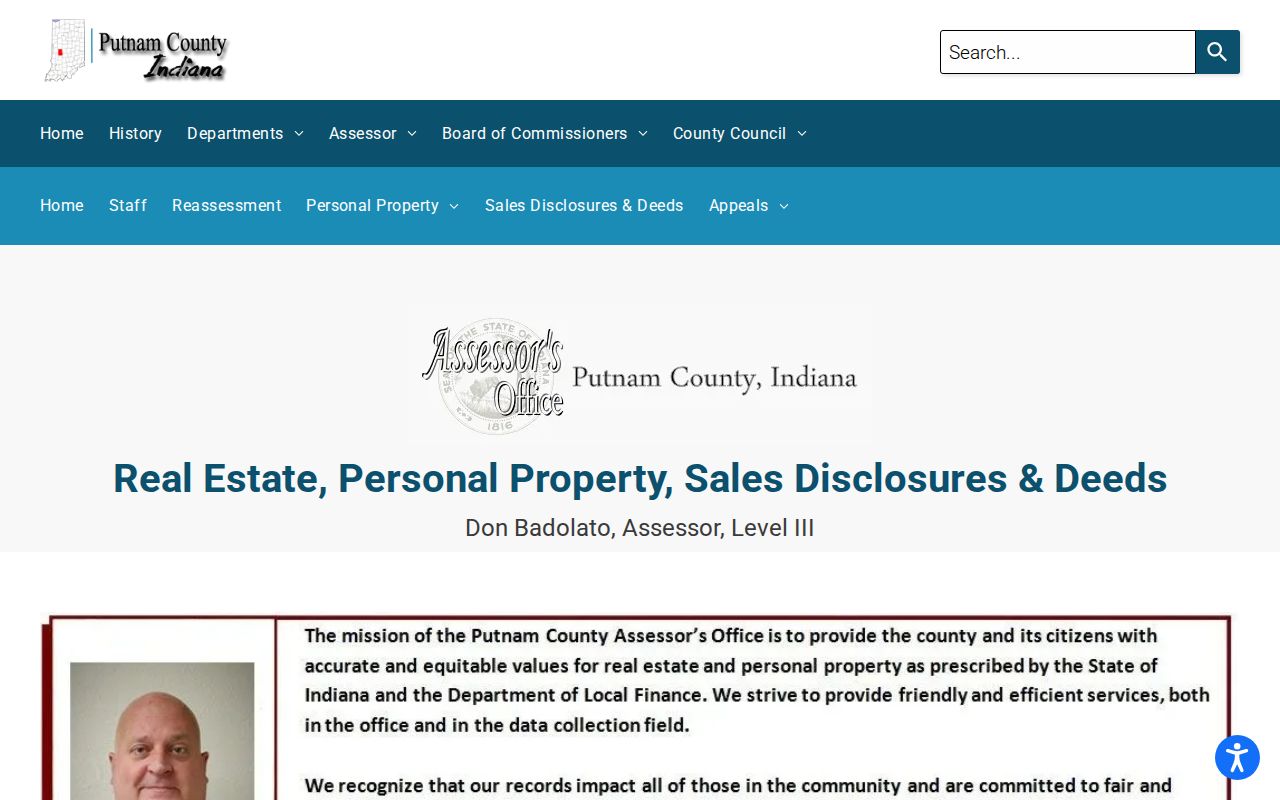
Weigh assessed value against a deed's consideration through that framework.
Putnam County Map Layers
Putnam County Think GIS draws the parcel geography, and the county's GIS download directory adds the rest: parcel boundaries, address points, roads, sales and CAMA tax exports, aerials, flood, soil, land-use, and district layers. A click on the map identifies overlapping features. An area query can select neighboring parcels or everything within a set distance.
These layers answer location questions well. Check road access, adjacent ownership, municipal labels, and physical change across them. A map line is not a legal boundary. Confirm every result against the legal description, recorded plat, easement, or survey. Save each download's name and update marker. Layers refresh on their own schedules.
Putnam County Property Record Types
Every Putnam County property record answers one narrow question. Deeds prove conveyance. Mortgages and releases mark recorded debt events. Assessment and tax files carry the county's administrative values and billing status, plats tie legal descriptions to mapped tracts, and permit and zoning files document land-use review under the correct city or county jurisdiction.
| Record Type | What It Documents | Kept By | Access |
|---|---|---|---|
| Deeds | Transfers, parties, dates, legal descriptions | Recorder | Doxpop index; office copy |
| Mortgages and liens | Recorded claims, assignments, releases | Recorder | Index; recorded image |
| Assessment and tax | Values, deductions, bills, payment status | Assessor, Auditor, Treasurer | Think GIS; tax list; office |
| Plats and parcels | Lot, block, tract, splits, mapped geometry | Plat Office and GIS | Viewer, downloads, books |
| Permits and zoning | Applications, inspections, land-use actions | Greencastle or county | City portal or office request |
Use the deed record for the legal transfer. Use the assessment record for value administration. Treat the map as a geographic aid only. Mortgages, releases, easements, covenants, and liens all belong in a Recorder search, while foreclosure, quiet-title, partition, and probate matters may call for an Indiana MyCase party search plus a certified Clerk copy.
Putnam County Permit Boundaries
Permit jurisdiction is the first key. A parcel inside Greencastle falls under Greencastle Planning and Zoning. That office handles city zoning, applications, maps, and board actions. The county Building and Planning Department covers unincorporated Putnam County. It also serves the towns of Bainbridge, Cloverdale, Roachdale, and Russellville. A postal city or ZIP label will not settle that line.
Pin the parcel in GIS first. Then take permit, inspection, variance, subdivision, floodplain, and zoning questions to the right office. Ask whichever office actually serves that spot. Searches can run by address, parcel number, owner or applicant, record type, and date range. An empty online result is not proof that no permit exists. The county's own jurisdiction statement spells out who administers what.
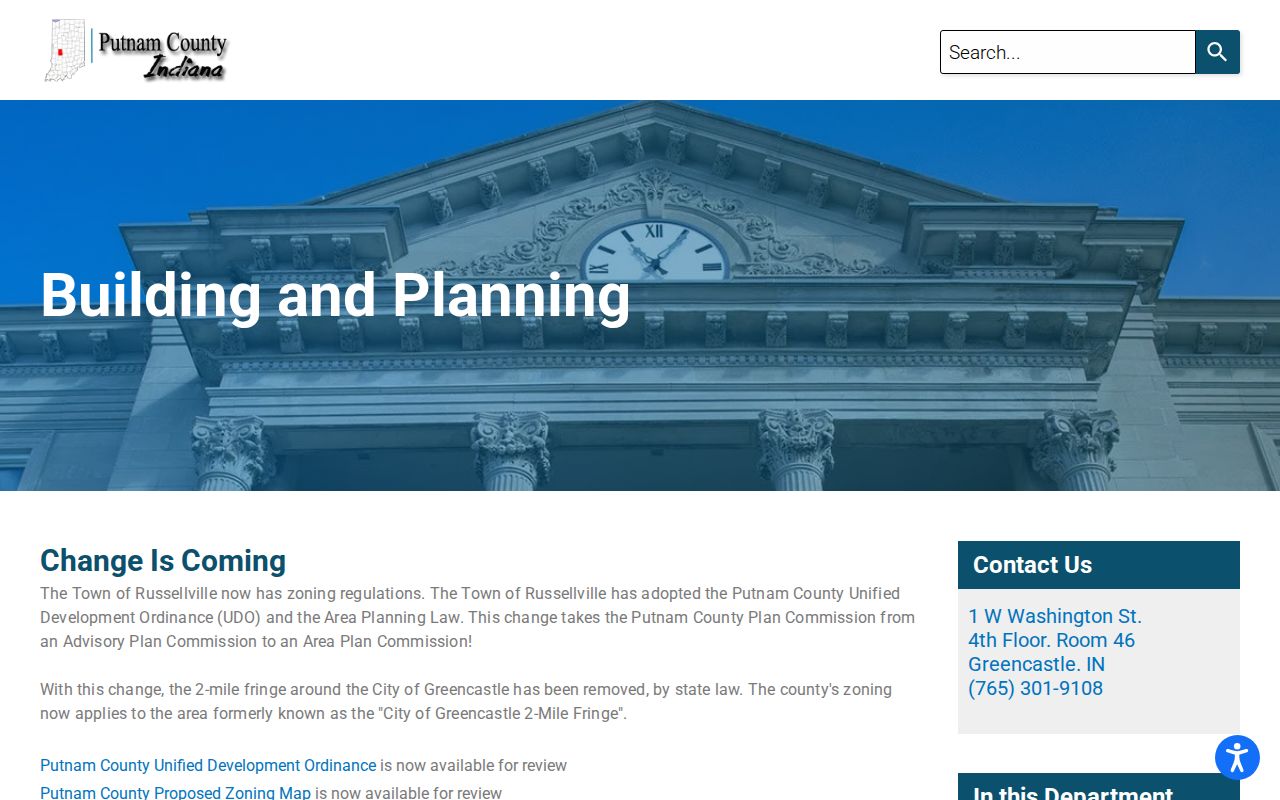
That split keeps a Greencastle city search from covering a parcel the county actually administers.
Putnam County Historic Land Records
Putnam County property records reach back well past the online deed window. The Plat Office keeps plat books, aerials, historical-owner references, and parcel-split material. The Indiana State Library lists county maps and atlases. It also lists city maps and owner indexes spanning 1864 through 2014. The Putnam County Public Library's Cyril Johnson Room adds newspapers and obituaries. The same room holds photographs, family histories, and court-record material.
Treat historic maps as leads. A single farm label may cover land later split into many parcels. Match the old road, township, section, lot, or block to modern GIS. Then bridge the gap with deeds and plats. The county-seat land donations reported for 1823 and 1825 make a useful local research trail. Precise conveyance claims still need the archival deed itself. The Plat Office holdings describe what is available.
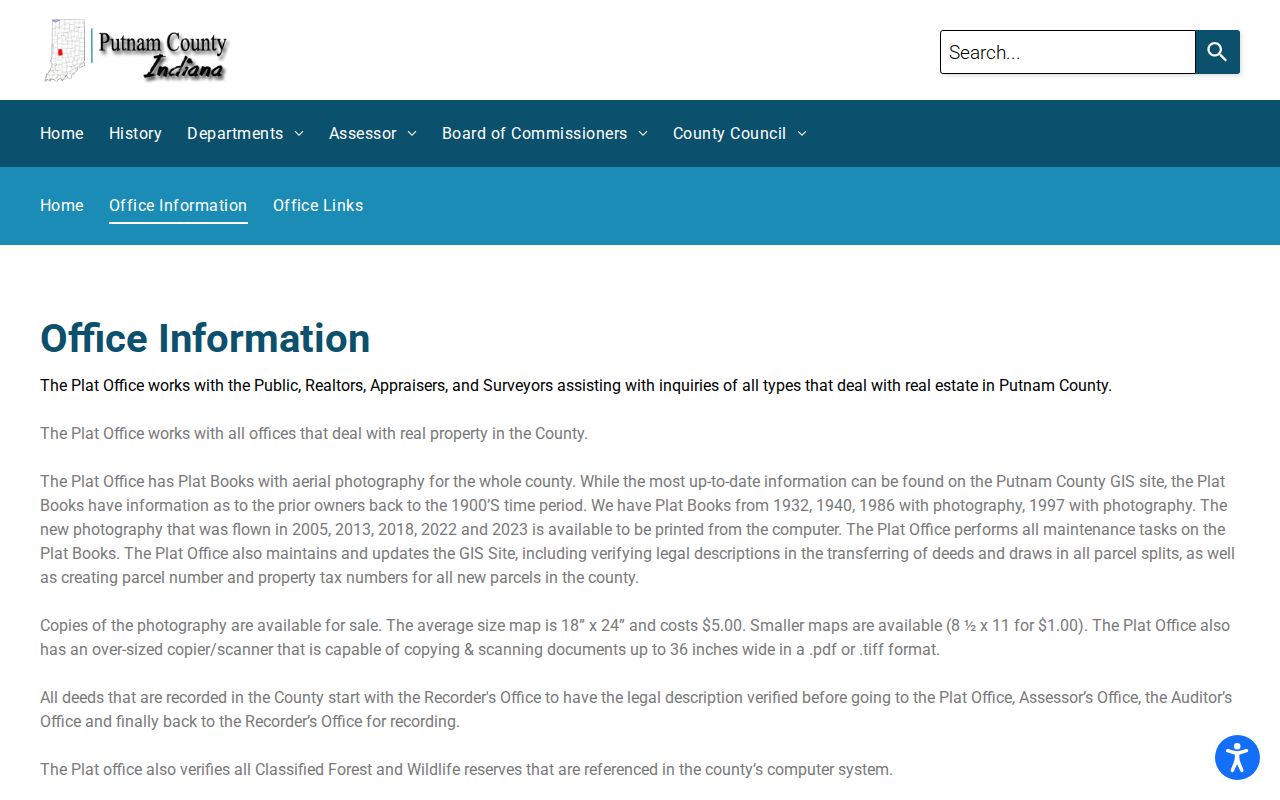
Those old plat books can bridge a changed parcel number or legal description that stalls a modern property search in Putnam County.
Putnam County Transfer Chain
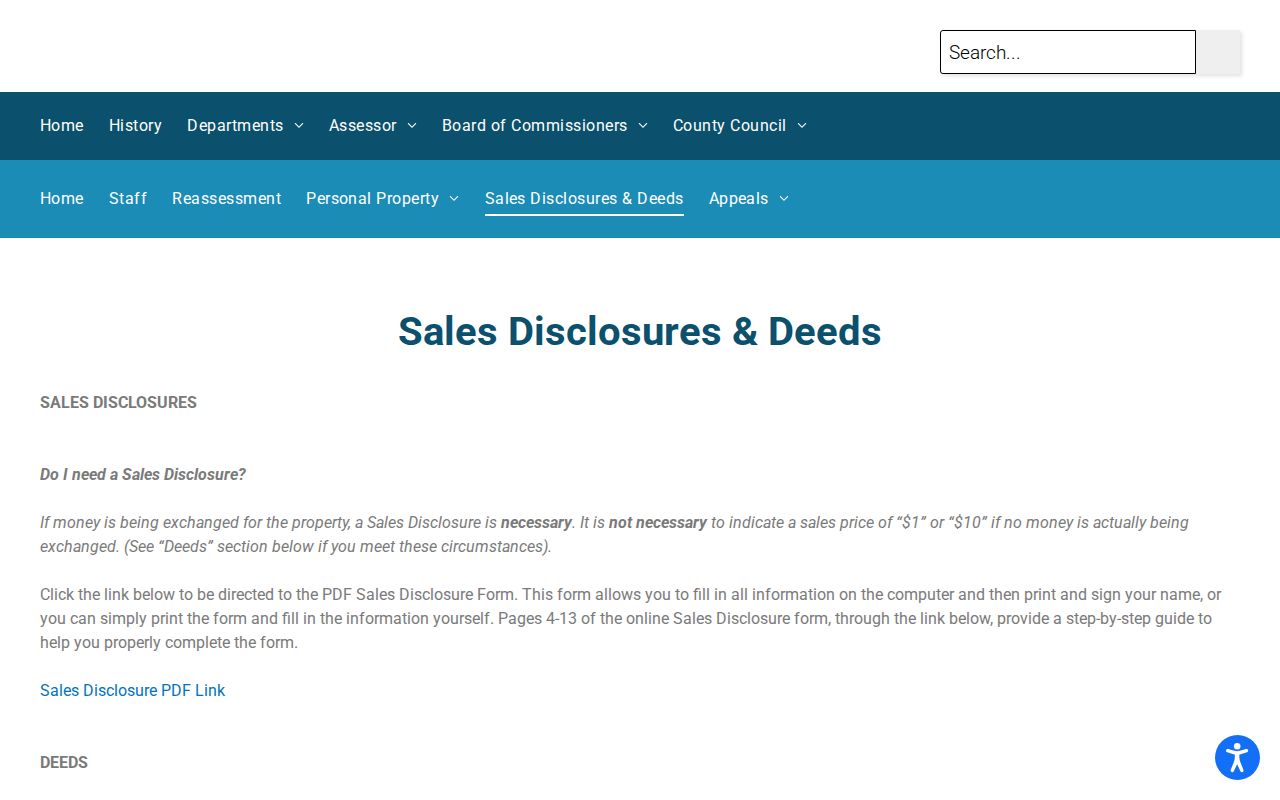
A local deed crosses several desks. The Recorder receives the instrument. The Plat Office reviews the legal description. The Assessor reviews the transfer. The Auditor processes it, and the Recorder finishes the recording. Money and no-money transfers follow county-described categories. Auditor fees may also apply by parcel. They may apply to a qualifying Sales Disclosure, apart from Recorder filing fees.
That sequence explains a familiar puzzle. The tax-list name, GIS card, and recorded grantee can differ for a stretch of time. The county publishes no set countywide update interval, so compare dates instead of guessing. Check the newest recorded deed. Then compare the map or tax observation date, and any office-confirmed pending split, combination, or correction. The county transfer workflow lays out the steps.
That gives a practical reason to reconcile deed records and assessor data instead of trusting one web name as final.
Putnam County Deed Alerts
Doxpop Property Watch sends free alerts built on a name or a legal-description term. It can flag a newly indexed instrument tied to Putnam County property records. Address and parcel number are not guaranteed alert keys. Short names or short legal descriptions may produce false positives.
Treat an alert as a prompt, not a conclusion. Pull the instrument and confirm the county, parties, legal description, document type, and recording data. Call the Recorder if an unexpected filing appears. The service does not freeze title. It does not replace periodic review of the official record. The name and legal-description setup shows how the terms are entered.
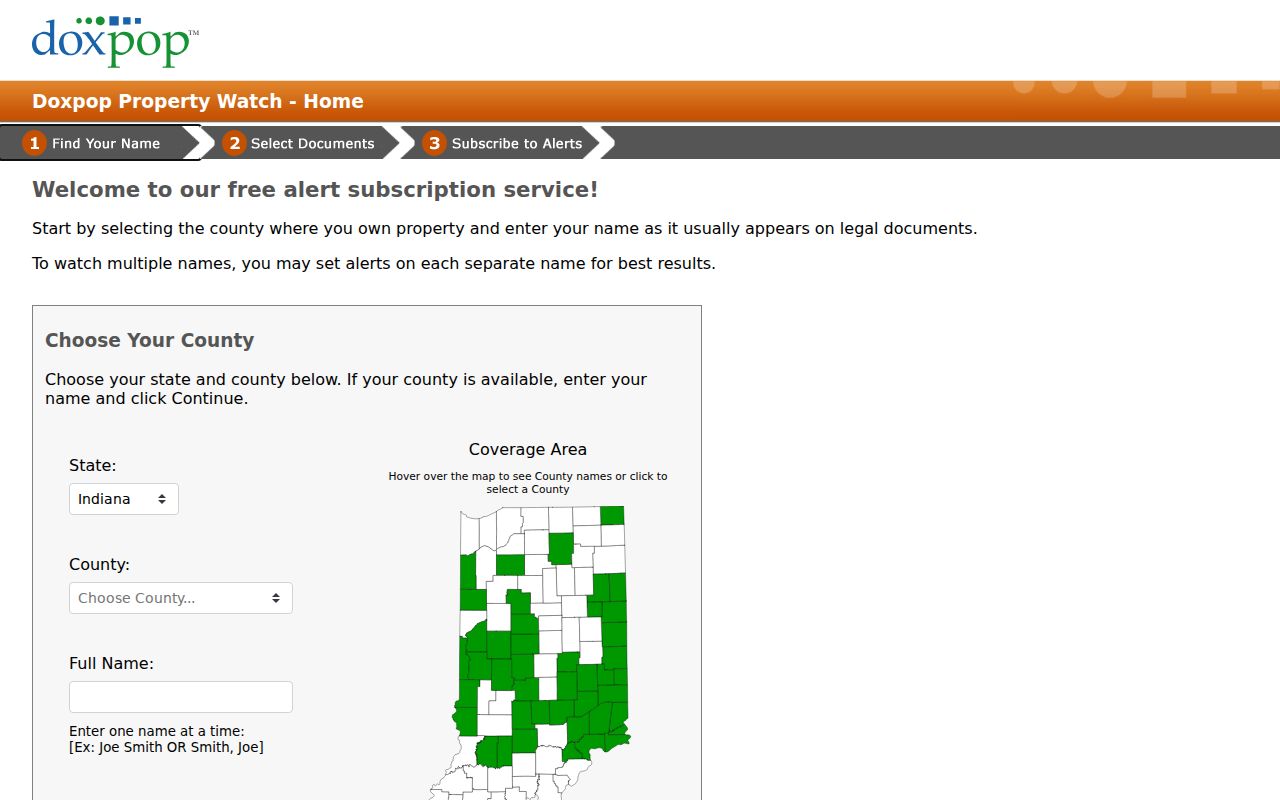
Pick distinctive search text to cut false matches, then confirm each alert against the recorded deed image.
Putnam County Tax Sale Trail
A delinquent-tax trail runs through separate events. It moves from the tax list, certification, notice and advertising, sale, certificate, redemption period, possible tax deed, and any later conveyance. The county Auditor and Treasurer publish tax-sale information and route users to SRI resources. A tax-sale certificate is not a tax deed, and neither is a later recorded transfer.
Build a date ladder. Work through the Treasurer and Auditor materials first. Then search the Recorder for the later deed. Check Indiana MyCase for related litigation. That discipline keeps a sale-list entry from being mistaken for present title.
Putnam County Search Terms
Names and addresses shift over time. Search a person's full name, initials, prior surname, trust capacity, estate style, or exact business name. Use each variant only where the record supports it. For an entity, the INBiz public business search can confirm the legal name and status. It does not replace the deed. For rural land, lean on section, township, range, tract, and road clues. For platted land, use subdivision, lot, block, replat, and correction terms.
- Parcel or APN
- The local identifier tying a tract to tax and map data.
- Grantor
- The party conveying an interest in a recorded instrument.
- Grantee
- The party receiving the recorded interest.
- Plat
- A recorded drawing that divides or describes land.
- Assessed value
- The value used in Indiana's property-tax system.
Keep raw and normalized addresses in the search log. A USPS city name serves mail delivery and may not identify the city or county permit authority.
Limits of Putnam County Records
Putnam County property records can document a recorded grantee, tax-list name, assessed value, legal description, recorded lien, plat, mapped parcel, tax status, or permit action. They do not prove who occupies an address. A missing online image does not mean no document exists. Some records carry legal access limits. Protected addresses, sealed cases, restricted vital records, and redactions are among them. These are access limits, not evidence gaps to work around.
When a record is not online, make a focused request under the Indiana Access to Public Records Act, IC 5-14-3. Name the office, parcel or address, document type, and date range. The agency must search for existing records described with reasonable particularity. It need not build a new report. Ask the Clerk for official court copies. Ask the Recorder for certified instruments.
Lawful use. Putnam County records support due diligence, boundary research, appeals, estates, and civic review. A search is not a title opinion or survey, and owner data must never be used to harass or harm.