
Trace Back Putnam County Owners
Putnam County prior owners come together one transfer at a time. Pull the current deed first. Identify its grantor. Then locate the deed through which that same grantor earlier acquired the land. Repeat the process. Keep legal-description notes beside every name. Street addresses, parcel numbers, and tract shapes can shift across decades of deed records.
| Transfer date | Grantor to grantee | Instrument | Reference |
|---|---|---|---|
| Newest first | Prior owner to current grantee | Deed as indexed | Instrument number or book/page |
| Next earlier | Earlier grantor to the prior owner | Deed as indexed | Match legal description |
| At an interruption | Estate, trust, tax, or corrected names | Deed plus related record | Record the gap and follow-up |
A reverse timeline keeps prior owners in order without leaning on a lone index snippet. Each entry should capture execution date, recording date, parties, deed type, legal description, parcel clue, image status, and the next grantor to chase in the property records.
Putnam's Online Deed Window
Doxpop vendor material indicates that Putnam County index documents filed in January 1992 or later, and images filed in January 1993 or later, may sit online. Treat that boundary as portal history. It does not promise a complete image or a perfect index entry for every deed. Use the Putnam recorded-document search until the chain hits its earliest result, a name ambiguity, or a changed legal description. Then move to the Recorder, the Plat Office, microfilm, and historical books. A dead end online is not proof that no former owners existed.
Online cutoff. The online lead begins around 1992 for index entries and 1993 for images; older ownership needs the paper and archival bridge.
Older Putnam Owner Books
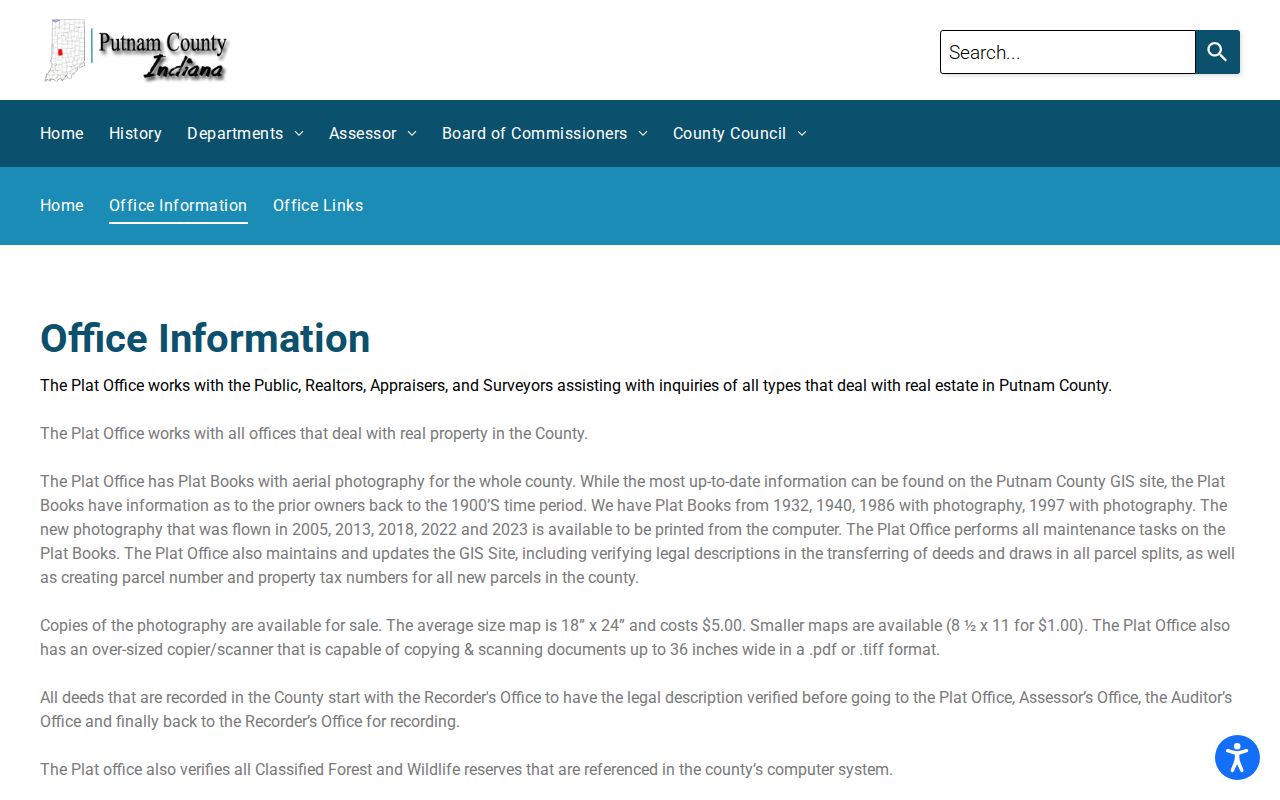
The Putnam County Plat Office keeps owner references reaching back to the 1900s. Its plat books with photography include 1932, 1940, 1986, and 1997. The office also verifies legal descriptions and assigns new parcel numbers after splits. Those duties can bridge former owners. They help when a modern parcel fails to match an old tract. Its documented holdings appear below.
Historic owner labels are leads, not conveyances, and every name must be tested against recorded deeds.
Reconstruct Putnam's Deed Chain
Read the Putnam County deed chain backward through the grantor-grantee link. Search exact and alternate name forms: middle initials, corporate suffixes, trustee styles, estate names, and likely misspellings.
- Locate the current conveyance and confirm the target legal description.
- Record the grantor as the immediately prior owner for that instrument.
- Search that grantor as a grantee and locate the earlier acquiring deed.
- Repeat until the online boundary or a documented interruption, then continue through the Recorder and Plat Office.
- Grantor
- The party conveying the interest described by the deed.
- Grantee
- The party receiving that stated interest.
- Reverse index
- An index used to find the deed by which a named owner acquired land.
- Chain of title
- The ordered recorded transfer trail for the same legal land.
Putnam Splits Change the Trail
A prior owner may have held a large tract later split into several parcels. A combination can work the other way. Compare old and new parcel numbers, lot and block, section-township-range, metes-and-bounds text, and replat references. The current GIS map polygon does not prove the old deed used the same footprint. The county GIS download directory offers parcel, address, and sales files. It also provides CAMA or tax files and historical aerial files. Note each file's update date. Tie geometry changes to Plat Office work. Then match them to recorded instruments. Only then add a name to the chain.
Estate and Trust Transfers
Probate, trust, and fiduciary transfers can break a clean buyer-seller sequence. Search capacity terms, estate names, trustee names, and personal-representative forms. Indiana MyCase can point to a Putnam probate matter. A recorded fiduciary deed supplies the land link. A death record, obituary, or court docket may explain the chronology. None of them conveys the parcel. Keep each source in its own evidence column.
Historic Putnam Map Owners
The Indiana State Library Putnam map list spans owner-indexed plats, atlases, city maps, and aerial sources from 1864 through 2014. A map can yield a name, road, subdivision, or tract clue. This helps when older deed indexing resists a property search. Modern parcels may not align one-to-one with a farm tract on an early plat. Treat the printed owner as a hypothesis. Then find the first recorded instrument. It should bridge the historic tract into the modern parcel genealogy.
Gauge Putnam Ownership Depth
Former owner research can reach past the online window. Recorder books, Plat Office references, county microfilm, the State Library, and the Putnam County Public Library's history collections all help. The county publishes no courthouse-fire loss and no universal earliest deed date, so claim neither. Document where the chain stops and why. A changed description, missing image, same-name conflict, tax deed, probate transfer, road right-of-way, or replat is an open issue. It is not license to fill the gap. The Putnam County Public Library's Cyril Johnson Room offers local obituaries, photographs, family histories, and court-record material. Staff help is available there too. Newspaper searches add dates and name variants. Use those facts to shape a deed-book search. Then return to the recorded instrument before treating a person as a former owner. A good archival request names the known owner, approximate dates, township or subdivision, and lot or tract description. Add the last verified deed reference too. Ask for an index or call-slip citation when no electronic image exists. Log the repository, collection, volume, page, and access date in the chain record.
Use the chain narrowly. Former Putnam County owners support title, estate, and property-history research. Never use past names to harass or track a living person.
For a certified image or one instrument's mechanics, use the county's deed-record route. The former owners inquiry stays fixed on time depth and unresolved links.